Comparative Study of Adaptive Robotic Arm Grasping with Human-Like Capabilities
A comparative study of giving a robot arm human-like grasping abilities — paper, slides and poster below.
Research2025Completed
About this project
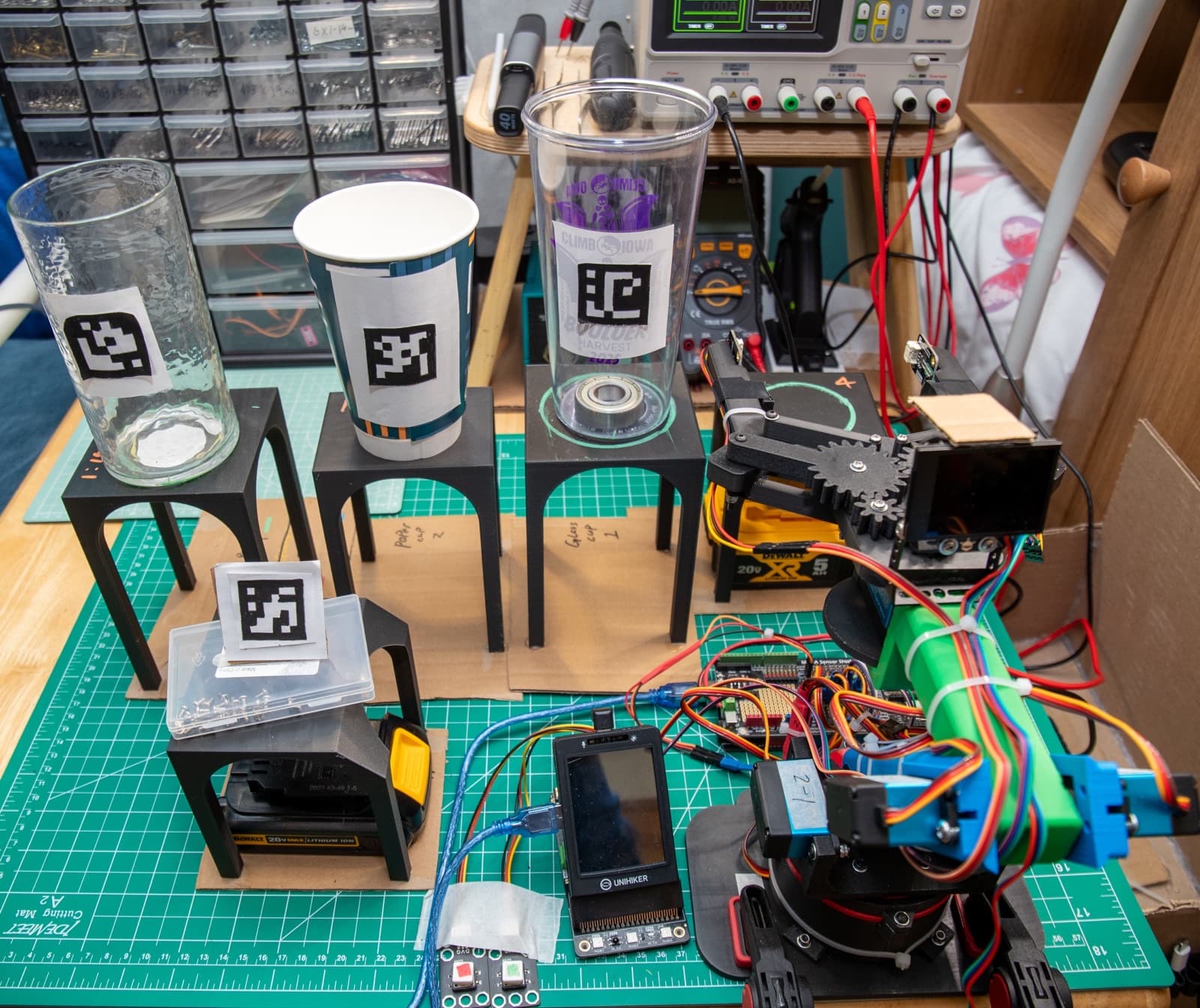
A robot arm in a bubble-tea shop has to grasp, carry and place liquid-filled cups made of paper, plastic or glass, and each material brings its own risk of the cup deforming, slipping or spilling. In this study I asked how to map three human abilities into robotic grasping: material intuition, commonsense choice of force and speed, and touch. I tested this on a tabletop setup built around my own three-axis arm.
I compared a fixed-parameter baseline, a vision + commonsense method that identifies each cup and loads matching grip and motion settings, and a closed loop that fine-tunes the grip from two pressure sensors, with 50 trials per cup and method. Vision + commonsense helped most on glass cups. Touch feedback was most effective on paper and plastic cups but did not raise the success rate on glass, where dropped cups stayed the main failure.
Project materials